
Analysts say long-term investors may still benefit, but recommend limiting bullion exposure to around 10 per cent.

Sensex and Nifty post steepest weekly loss in over a year, falling nearly 3 per cent.

'The problem is not just slower growth, but also the quality of growth.'

Prime Minister Narendra Modi convened the Cabinet Committee on Security to address the impact of the West Asia conflict on Indian citizens, focusing on safeguarding them from the conflict's effects and ensuring the smooth flow of essential supplies.

Two expatriate workers were killed after debris from a downed drone fell in an industrial area in the Sohar province of Oman.

The Indian rupee depreciated by 52 paise to settle at 93.35 against the US dollar, driven by failed US-Iran peace talks, surging crude oil prices due to a potential US blockade of Iranian ports, and a global flight to the greenback. This geopolitical uncertainty is also leading to foreign capital withdrawal from domestic equities.

The Indian rupee rebounded against the US dollar after the Reserve Bank of India (RBI) restricted banks' net open positions in dollars. This move prompted banks to sell dollars, providing temporary support for the rupee amidst ongoing geopolitical tensions and rising oil prices.

A French soldier was killed while several others were injured in an attack in the Erbil region of Iraq, French President Emmanuel Macron confirmed. Macron, in a post on X, confirmed that Chief Warrant Officer Arnaud Frion of the 7th Battalion of Chasseurs Alpins lost his life in the attack.

India emerged reasonably well from 2025. But now, the oil shock and war-related supply disruptions have again driven funds out of India and significantly weakened the rupee, points out Ajay Chhibber.

India summoned the Iranian envoy after two Indian vessels had to reverse course in the Strait of Hormuz following an incident of firing by Iran's Revolutionary Guards.

We who were dreaming of being the third largest economy in dollar terms, have slid back to sixth, thanks to the falling rupee. We are moving about with begging bowls for investments and trade opportunities, which will be a while in materialising, if ever, notes Shreekant Sambrani.

The Congress has strongly criticised the US government's temporary waiver allowing India to purchase Russian oil, raising concerns about continued 'American blackmail' and its impact on India's energy policy.

'Historically, India has depended on the Middle Eastern Gulf for nearly 90 per cent of its LPG imports. Shifting to alternative suppliers is not something that can happen quickly.'

Global brokerage Bernstein has issued a cautionary note, stating that India risks 'under-delivering on its potential' unless it addresses key policy bottlenecks and structural risks, including employment challenges from AI, limited manufacturing gains, and rising welfare spending.

The Indian government has convened an all-party meeting to discuss the ongoing crisis in West Asia, following Prime Minister Modi's address to Parliament on the situation and its potential impact on India.

The Indian government's decision to ban sugar exports until September 30 has drawn sharp criticism from the sugar industry and farmer leaders, who fear long-term negative impacts despite the stated aim of controlling domestic prices and ensuring availability.

Pakistan is playing a key role in facilitating talks between the US and Iran, but the future of these negotiations remains uncertain. Despite ongoing diplomatic efforts, no dates have been set for a second round of discussions.

Tesla has launched its second model in India, the three-row six-seater SUV Model YL, priced at Rs 61.99 lakh, while also announcing plans to expand its service and body shop network across major Indian cities. The company is also considering bringing its humanoid robot Optimus and vertically integrated energy solutions business to India at an appropriate time.

Iran has asserted that maritime movement through the Strait of Hormuz will be strictly controlled by Tehran, stating that passage will be allowed only through designated routes and under Iranian approval.

Foreign investors have aggressively sold off Indian equities, withdrawing over 48,213 crore in the first 10 days of April, following a record 1.17 lakh crore outflow in March, driven by escalating geopolitical tensions in West Asia, rising crude oil prices, and global inflation concerns.

India significantly increased piped natural gas (PNG) connections in March as the government accelerates the expansion of cleaner fuel networks amid global supply disruptions.

'OMCs are incurring losses of Rs 1,000 crore per day due to the West Asia crisis.'

The Beijing summit may have reduced immediate diplomatic uncertainty, but it did not resolve the deeper structural contest between the United States and China. That contest appears likely to define the coming decade, notes Varun Arya.

JPMorgan has downgraded Indian equities to 'neutral' from 'overweight', citing elevated valuations, rising earnings risks, and limited exposure to next-generation technology like AI. The brokerage believes other emerging markets offer more attractive risk/reward propositions despite India's strong structural growth story.

In the latest Rediff series exploring non-traditional careers, Sandeep Goel, professor and dean-research at MDI, Gurgaon lists a range of high-growth finance careers beyond CA, CS, and MBA degrees.

US Vice President JD Vance leads a delegation to Islamabad for talks with Iran, expressing optimism while warning against bad faith negotiations from Tehran.
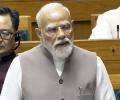
Prime Minister Narendra Modi addressed Parliament on the West Asia crisis, advocating for dialogue and diplomacy, ensuring the safety of Indians in the region, and addressing concerns about fuel and food security.

Calling such reports baseless, Finance Minister Nirmala Sitharaman said there was no such move under consideration.

The US President clarified that these negotiations do not involve the new Supreme Leader, Mojtaba Khamenei.

Despite the ongoing West Asia conflict causing global trade route disruptions, Mercedes-Benz India reports resilient customer demand, particularly for its new electric CLA sedan, though it faces challenges with component supply delays and escalating shipping costs.

Commodity markets, especially the metals, are among the most volatile segments of the Indian financial ecosystem. To traders involved in commodity trading, it is not only helpful to keep track of the daily price changes but also necessary to make informed trading decisions. Commodities like gold, silver, copper, and aluminium react to many different factors, which makes it imperative for commodity traders to watch out for metal prices every day.

The measures announced by it risk backfiring, disrupting the foreign exchange market, and intensifying the very pressures they seek to contain, with broader consequences for the economy points out Rajeswari Sengupta.

Indian stock market indices Sensex and Nifty experienced a significant drop in early trade, reversing a three-day rally. The decline was triggered by a sharp increase in crude oil prices, weak global market trends, and continuous outflows of foreign funds.

Moody's Ratings has downgraded India's growth forecast for financial year 2026-27 (FY27) to 6 per cent from 6.8 per cent, attributing the revision to weaker consumption and industrial activity, elevated energy prices, and rising input costs stemming from the West Asia conflict.

Historically, India was a major buyer of Iranian crude, importing significant volumes of Iranian light and heavy grades due to strong refinery compatibility and favourable commercial terms.
Crude oil prices experienced a sharp decline after US President Donald Trump announced a temporary halt to military strikes on Iran's energy infrastructure, easing geopolitical tensions and supply disruption fears.

Iranian news agencies have denied reports of Iranian officials travelling to Pakistan for negotiations with the United States, even as Pakistan prepares for potential talks and faces criticism from Israel.

Commerce and Industry Minister Piyush Goyal announced that a US team is expected to visit India next month for trade talks, following an earlier Indian delegation's visit to Washington, DC, in April to finalise an interim pact and advance negotiations for a broader bilateral trade agreement.

West Asia conflict triggers sharp sell-off in Indian markets, with realty, banking and auto stocks leading losses amid energy shock fears.

The increase in energy consumption was driven by renewables and natural gas, which together contributed three quarters of the expansion.
